
Your Most Critical Servers
Are Your Least Protected.
JetPatch Offline Windows Patching delivers Microsoft updates to Windows servers with no internet access. Only the JetPatch Manager reaches Microsoft, every update is verified by digital fingerprint, and isolated servers install from a local store, then are re-scanned to confirm.
Deliberate Isolation Creates an Unintended Liability.
Production floors, financial services, healthcare, defense, and OT environments seal their servers by design. Security teams built it that way — and were right to. The problem is what isolation does to patching.
What Manual Patching Costs You Today
Ask how long it takes to patch a server with no internet access. The honest answer in most environments is rarely measured in days.
-
Standard patching pipelines require internet access. Tools that rely on Windows Update or cloud connectivity cannot reach truly air-gapped servers without significant manual workarounds.
-
Manual or scripted workarounds are slow and error-prone. Whether using USB drives, PowerShell scripts, or intermediate servers, most existing approaches require significant manual effort and provide no automated verification that the right update reached the right machine intact.
-
No audit trail. No record of who approved what, what was installed where, or when. An auditor cannot be shown evidence that does not exist.
-
Isolated but drifting. Unpatched hosts become the softest target for lateral movement inside your own network.
-
Compliance frameworks do not accept "we're air-gapped" as an answer. ISO 27001, NIS2, and PCI-DSS require evidence that all systems are patched on a defined cadence.
Four Dimensions. One Clear Difference.
Every dimension security officers and auditors ask about — and what changes on each when offline patching is automated.
| Dimension | ❌ Without JetPatch | ✅ With JetPatch |
|---|---|---|
| Patching Cadence | Irregular and manual. Most approaches require USB drives, PowerShell scripts, or complex intermediate server configurations — and few verify the result. | Scheduled and automatic. Same monthly cadence as the rest of your fleet, in your maintenance window. |
| Security & Verification | Unverifiable. Nothing proves the file that reached the server is the file Microsoft published. | 100% digital-fingerprint verified. Anything that fails is quarantined and never reaches a server. |
| Network Exposure | Air-gapped but drifting. Unpatched hosts become the softest target for lateral movement. | Zero new internet exposure. Servers gain no internet access at all. One controlled doorway does the work. |
| Auditability | Impossible to prove. No approval trail, no installation record, no report to hand over. | Audit-ready by default. Who approved what, installed where and when — one report, one console. |
We Don't Bring Servers to the Internet.
We Bring Verified Updates to Them.
One controlled doorway to Microsoft. Everything else stays sealed exactly as your security team designed it.
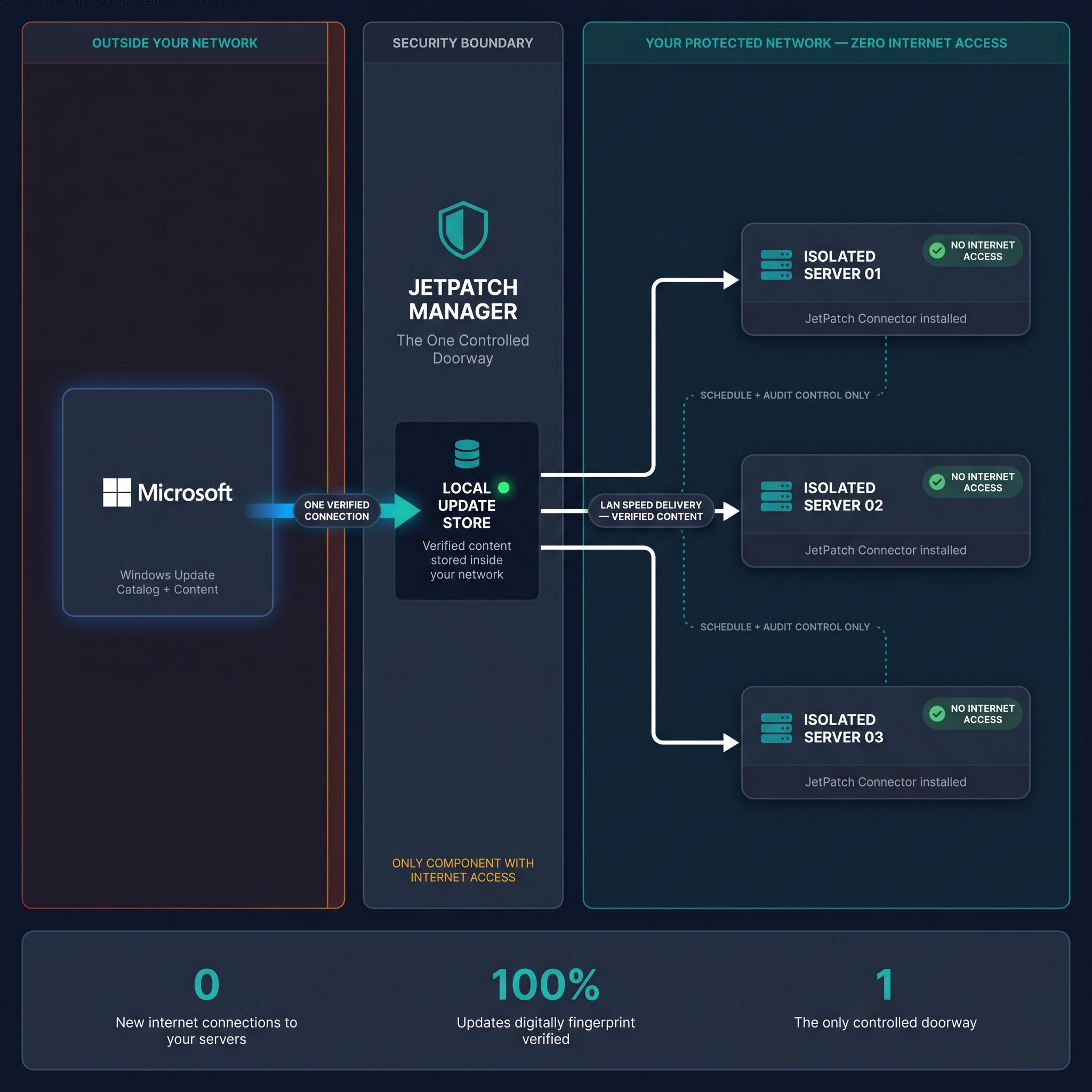
One Controlled Doorway
The JetPatch Manager is the single crossing point to Microsoft — the only component that ever reaches the internet. Nothing else crosses.
Your Isolation Is Unchanged
Isolated servers stay exactly as isolated as they are today. They talk only to JetPatch, inside your network, and gain absolutely zero new exposure.
Fetched Once, Verified, Stored Locally
Every update is pulled through the doorway once, integrity-verified against Microsoft's own catalog, and kept in a local store for distribution at LAN speed.
Twelve Steps. Proven Compliance.
Follow the sequence from discovery to audit-ready proof. Only steps 01 and 07 ever touch the internet — both executed by the JetPatch Manager, never by your servers.
Isolated Servers. Enterprise-Grade Patching.
Five outcomes — and not one of them is paid for with new network exposure.
Closed Attack Window
Isolated servers patched on the same predictable monthly cadence as the rest of your fleet, in the maintenance window you choose.
Nothing Unverified, Ever
Every single update is digital-fingerprint checked before a server sees it. Suspicious or failed content is automatically quarantined.
Audit-Ready by Default
Who approved what, what was installed where, and when — captured as you go and produced as one report from one console.
No New Exposure
Servers gain absolutely zero internet access. Your network architecture stays exactly as your security team designed it.
No Extra Staff Effort
Complex manual workarounds — USB drives, scripts, and intermediate servers — replaced by scheduled, reliable automation in the same console you already use.
Perfect Isolation. Completely Proven.
Every framework asks the same two questions: are all systems patched on a defined cadence, and can you prove it? JetPatch offline patching changes the answer for the very machines where it used to be no.
Yes — for the very servers where the answer used to be no.
For air-gapped servers the honest answer has always been no on both compliance counts: patched when someone had time, and with no evidence to hand an auditor. That changes.
See Offline Windows Patching in Action.
Tell us about your air-gapped environment and we'll show you exactly how JetPatch handles it.
Questions We Hear Every Time.
The Full Patching Platform
Windows Patch Management
WSUS and WSUS-Less patching for connected Windows environments.
→Linux Patch Management
Advisory-level patching for RHEL, Ubuntu, SUSE, and 8 distributions.
→Unix Patch Management
Oracle Solaris and IBM AIX patching from the same console.
→Patch Management Overview
20+ operating systems from one console. The full platform picture.
→