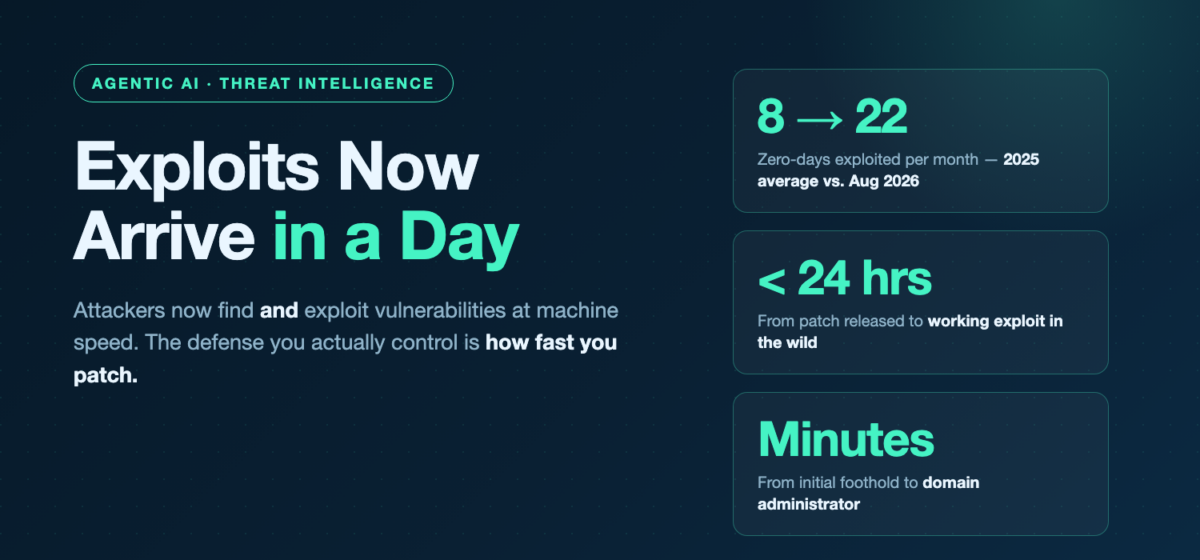
On November 16, 2026, Google’s Threat Intelligence Group reported something defenders have been bracing for: attackers are now using AI agents to find and exploit vulnerabilities on their own — what GTIG calls operating at machine speed, with no human driving each step. That is not a future problem. It changes the math on one thing you already own: how fast you patch.
The window to patch just collapsed
The headline isn’t that AI writes malware. It’s the speed. GTIG’s numbers tell the story: zero-day exploitation climbed from an average of 8 per month in 2025 to 11 per month in 2026, then spiked to 22 in August 2026 alone, with disclosures and exploits nearly doubling between January and August.
Look at how fast exploitation now follows disclosure:
- PaperCut print servers. Attackers chained two flaws (CVE-2026-81578 and CVE-2026-82078) into unauthenticated remote code execution and expanded an initial foothold to domain administrator within minutes. The campaign hit hundreds of organizations; one exploitation wave was observed just four days after disclosure.
- PHP. After CVE-2026-109618 and CVE-2026-109619 were patched on October 21, working exploits appeared within a day — alongside hundreds of throwaway, AI-generated proof-of-concepts flooding the noise floor.
When a usable exploit lands the day after a patch ships, a 30-day patch SLA isn’t a plan. It’s a 29-day open door.
The uncomfortable part: these are known, patchable CVEs
The agentic frameworks GTIG tracked — harnesses wired to 100+ and even 150+ offensive tools, coordinated by a dozen autonomous sub-agents — aren’t burning precious zero-days on you. They don’t have to. They scale known vulnerabilities against internet-facing systems that simply haven’t been patched yet. The CVEs above all had fixes available. The breaches happened in the gap between “patch released” and “patch deployed.”
There is one piece of good news in the report, and it’s worth holding onto: GTIG notes these frameworks today trade stealth for velocity — they’re fast but noisy, not yet subtle. That means the contest, for now, is speed against speed. The side that closes the window faster wins. And closing that window is a solved problem — if you’ve automated it.
Human-speed patching loses to machine-speed attacks
Here’s the mismatch. On the offense, discovery, weaponization and exploitation are collapsing into a single automated loop. On the defense, patching at most shops still runs on human time: a monthly cycle, a spreadsheet of CVEs, a ticket queue, a change-approval meeting, someone RDP-ing into servers one at a time. You cannot win a machine-speed race with a manual process — and you can’t fix it by simply patching faster and blind either. The Windows updates that bricked machines earlier this year are a reminder that a reckless rollout is its own outage.
The answer isn’t heroics. It’s turning remediation into the same kind of automated, repeatable pipeline the attackers are using — just pointed at closing holes instead of opening them.
What to do now
- Shrink time-to-patch on anything internet-facing. Exposed services — print servers, web stacks, VPNs, mail — are where the agents land first. These get hours, not weeks.
- Prioritize by what’s actually being exploited, not just CVSS. Known-exploited and actively-weaponized flaws jump the queue.
- Automate the whole loop: discover, prioritize, stage, test on a pilot group, deploy in waves, verify, and report — without hand-touching each server.
- Keep staged rollout and automatic rollback so you can move at speed without turning a patch into your own outage.
- Cover the long tail. The hits weren’t all Windows — PaperCut, PHP, Linux. Third-party applications and non-Windows systems need the same discipline, from one place.
How JetPatch helps
JetPatch automates and orchestrates patch remediation across Windows, Linux and Unix and third-party applications from a single console — so the time between a fix shipping and your fleet being patched is measured in hours, not weeks. You can prioritize vulnerabilities, stage rollouts from a test group to production, validate endpoint readiness before deployment, roll a failed update back automatically, manage exemptions, and produce compliance reports that prove where you stand. For isolated networks, JetPatch Offline Patching keeps air-gapped servers current without giving them internet access.
JetPatch won’t detect an AI agent or replace your EDR — that’s not its job. Its job is to close the known vulnerabilities those agents exploit for initial access and lateral movement, and to close them faster than a human process can. In a machine-speed world, that’s the half of the fight you can actually automate.
Ready to patch at machine speed? Request a JetPatch evaluation and see how fast your Windows, Linux and third-party fleet can go from “patch released” to “patch verified.”