Walk through any enterprise server and you will find it crowded with agents. A log forwarder for Splunk. An EDR sensor for CrowdStrike. A monitoring agent for Zabbix. A vulnerability scanner, a backup agent, a change-analytics agent. Each one installed, upgraded and fixed on its own schedule — usually by hand.
Now a second kind of agent is arriving on the same servers: autonomous AI agents that write code, call tools and act on their own. The question for IT and security teams is no longer just “how do we manage our tool agents?” It is “how do we manage every agent on our servers — including the ones that think for themselves?”
Server agent management is not a new problem
Tool-agent sprawl has been a quiet operational tax for years. When an agent crashes, drifts from its configuration or stops reporting, the gap often goes unnoticed until an incident review asks why logs or alerts were missing. When a new version ships, someone has to roll it out across thousands of servers. When two agents compete for CPU, the server’s real workload suffers.
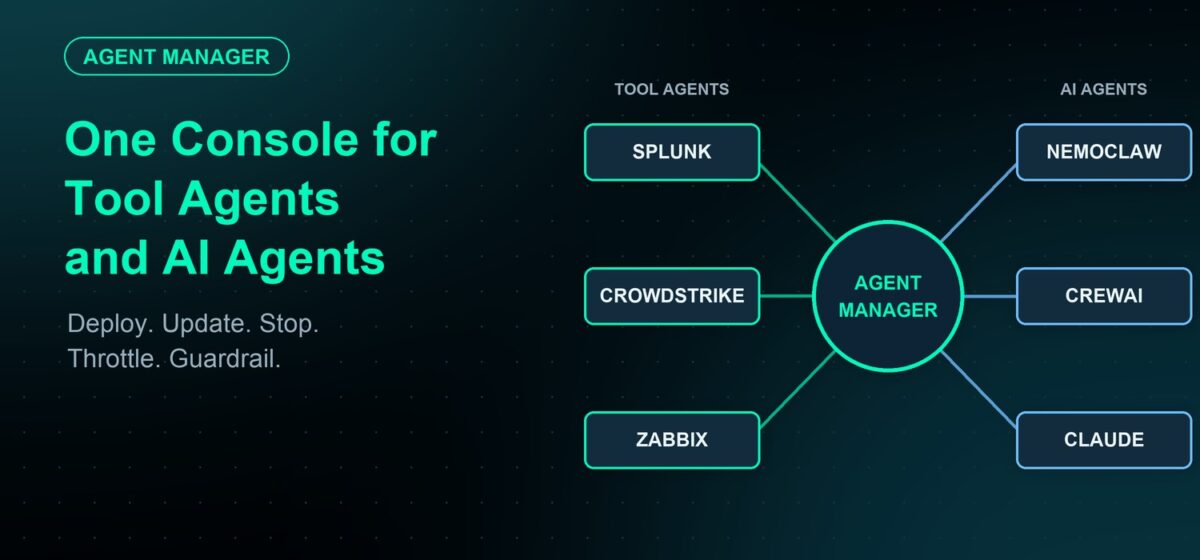
JetPatch Agent Manager was built to solve exactly that. For more than a decade it has run in production at one of the world’s largest global consulting firms, packaging each tool agent into an isolated VAI container and managing 50+ agents — Splunk, CrowdStrike, Zabbix, Rapid7 and more — from a single console.
AI agent management needs the same controls — and a few more
Everything that makes tool agents hard to run at scale applies to AI agents, with higher stakes. An AI agent that misbehaves can execute commands, burn through an LLM budget or overload a server running a local model. The controls that matter are familiar:
- Deploy and update — roll agents out across cloud, on-prem and hybrid servers, and push updates fleet-wide.
- Stop — a kill switch that pauses or suspends agent processes instantly when behavior looks wrong.
- Throttle — CPU and memory limits for tool agents; token budgets and CPU governance for AI agents.
- Guardrails — policies that decide what an agent may do, enforced where it counts. JetPatch Execwall evaluates every shell command, network call and tool invocation an AI agent attempts before it reaches the operating system.
- Audit — a record of what every agent did, ready for compliance reviews such as SOC 2 and the EU AI Act.
Why one agent manager beats two
It is tempting to buy a separate tool for AI agents. But tool agents and AI agents live on the same servers, are owned by the same infrastructure teams and answer to the same auditors. Two managers mean two inventories, two policy models and two places to look when something goes wrong.
JetPatch takes the opposite approach: one console, one inventory and one policy engine for every agent on every server. The team that keeps Splunk forwarders healthy can apply the same discipline to NVIDIA NemoClaw, OpenShell, Claude-based or CrewAI agents — without learning a new platform.
Questions to ask about your agent estate
- Do you know every agent running on every server — and which version?
- If an agent stops reporting tonight, will anyone notice before tomorrow?
- Can you stop a specific AI agent across all servers in seconds?
- Is there a hard limit on what an AI agent can spend or execute?
- Could you show an auditor what every agent did last month?
If any answer is “no,” see how JetPatch handles server agent management and AI agent management from one console, explore the AI Agent Cockpit and Execwall, or book a demo.